

Exploring the Western NY Wilds By Bob Confer
One of those more abundant wildflowers of the summer and fall, Queen Anne’s Lace, is starting to bloom now.
Everyone has seen this plant — it is ubiquitous, as impressive stands of the white flowers can be found on roadsides, along rail lines, in pastures, or in hedgerows.
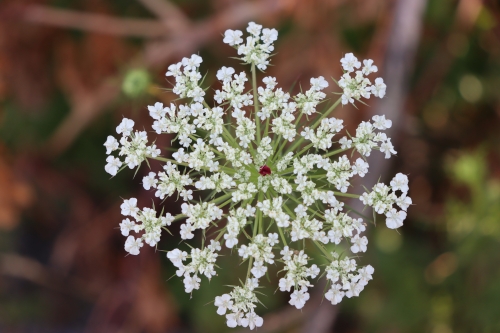
If you look closely, you will see that what you thought was a large white, circular flower is really an umbel, or a collection of dozens, even hundreds, of small flowers coming from a single stem. Collectively, they make for a lace-like appearance (hence the name) which I’ve always thought was best compared to a doily.
Some of them, but not all, will have a lone purple flower near the center of the umbel.
No one knows why that loner exists – some botanists blame a genetic flaw, while others say that it makes insects assume that there is a bug on the umbel, which attracts predatory wasps and the like to the plant, which become incidental pollinators.
The myth behind that purple random flower is that Queen Anne, when she was sewing the lace, pricked herself with her needle and it’s a drop of her blood that darkened that flower (by the way, no one knows for sure if it was named after Queen Anne of Great Britain or Queen Anne of Denmark).

As the summer progresses and the flowers have done their deed, they wilt and curl up, becoming brown and cup-like; hence another common name: bird’s nest.
The Queen Anne’s Lace is a non-native species. It was brought here from Europe because early settlers needed a foodstock and the prolific wildflower provided it. The Queen Anne’s Lace is a precursor of the modern cultivated carrot. It produces a root that smells and tastes just like the carrots you know and love. Unlike farmed carrots, the roots are very small (1 to 3 inches) and it takes quite a few to make a meal. The roots need to be picked when young. As they age, they become starchy, even woody and do not taste good at all.
I strongly suggest against eating any wild carrots unless you are familiar with plants. Queen Anne’s Lace can be easily confused with its cousin, far less common the poison hemlock, the same plant that infamously killed the Greek philosopher Socrates.
Death by consumption of poison hemlock is painful and labored – it causes muscular paralysis which ultimately prevents respiration from occurring, so the poisoned individual slowly, not quickly, suffocates. As few as a half dozen hemlock leaves will lead to death.
You also need to be careful when picking Queen Anne’s Lace if you are looking to make a centerpiece of the flowers or remove the invasive species from your garden. The plant juices can cause phytophotodermatitis. If you’ve seen the scary TV news reports or social media posts about giant hogweed every summer for years, then you are familiar with what that is. The juices get on a person’s hands, which leads to hypersensitivity to ultraviolet light for approximately 24 hours; the skin, being unable to protect itself from the sun, blisters badly. So, if you’re going to pick these flowers, wear gloves. And, encourage your kids to not touch the plants.
So, approach Queen Anne’s Lace with a little awareness, even some trepidation. If you are going to eat it or eliminate it, do so with care. Sometimes, the most beautiful of living things come with risks.
Bob Confer pens Exploring the Western NY Wilds from a lifetime of exploring, researching, and appreciating our natural world in WNY. You can reach him anytime, Bob@ConferPlastics.com