

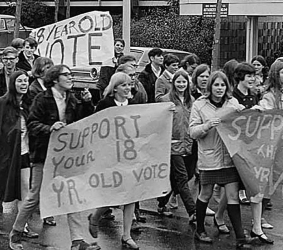
Pictured is a 1968 Right to Vote at 18 march
A COLUMN By Kathryn Ross
Most everyone realizes that voting in this year’s Midterm Election is important. It does not matter if you are a blue voter or a red voter, casting New York’s 2-page ballot will help determine the future of the country.
In my lifetime there have been two changes to voting procedure.
Most of my life there has been only one day set aside to cast your ballot. The calendar designated the first Tuesday in November as Election Day. That changed in October and November 2019. That year, the nine days prior to Election Day were set aside by the New York State Legislature for Early Voting.
It was an off-year election with only three House seats – Kentucky, Mississippi, and North Carolina – to fill, a few Gubernatorial offices to decide, and a variety of local elections on the ballot.

According to statistics kept by the NYS Board of Elections more than 256,000 people voted early for that year. Just under 3 million voters took part in early voting in 2024.
Early Voting starts Saturday, Oct 24th, in two locations in Allegany County. One location is at 23 North Main Street in Wellsville – the Village Hall. The voting machines will be in the trustee’s room. Voting starts at 9 a.m. and continues until 5 p.m. Saturday and Sunday. During the week voting is from 8 a.m. to 4 p.m.
The second location is the fire hall in Belmont, the former Off Duty restaurant at 5184 State Route 244. Voting there is the same as in Wellsville except for Monday and Wednesday when the poll will be open until 8 p.m.
Any Allegany County registered voter may cast their ballot at either location.
The second change in voting laws is a little bit more pertinent.
They used to say, ‘If you can remember the 1960s, you weren’t really there.’ Well, I was there, and I remember. I was not in a large city or on a college campus for most of the decade. I was in high school. Television was the looking glass through which I saw the protests on college campuses, the marches, and the discontent with our government.
In the 60s American youth were not allowed to vote until they turned 21 years of age, but young men could be drafted into the military and sent overseas to fight in a war. Women were not drafted, but we were concerned for our friends, our brothers, and others who could be drafted into the military. We may not have had draft cards, but we stood with our brothers.
Historically the drive to lower the voting age from 21 to 18 grew across the country during the 1960s, driven in part by the military draft held during the Vietnam War. The draft conscripted young men between the ages of 18 and 21 into the United States Armed Forces, to serve in Vietnam. While teenagers could be required to fight and die for their nation, they did not have a legal say in the government’s decision to wage war. Demanding change, we shouted, ‘Old enough to fight, old enough to vote.’
I argued a lot with my father in those years. He was a World War II veteran. I always thought it was funny that our parents, who had fought to preserve our rights, did not understand when we demanded our rights. They had taught us the need to fight. Yet when we protested on college campuses, marched in the streets, carried signs, took over buildings, and sang songs, they didn’t understand that we were doing exactly what they had taught us – fight for our rights.
We had learned the lesson, but to our parents and teachers we were belligerent, ungrateful, misinformed youth who didn’t appreciate our country.
We were as patriotic as they were. We wanted a country that lived up to our expectations. We demanded the right to vote.
Amendment XXVI of the United States Constitution establishes a minimum age of 18-years for participation in state and federal elections. It was proposed by Congress on March 23, 1971. By July 1, 1971, it had been ratified by 37 states.
For me and my generation it was ironic when the amendment became a law. After marching in the streets and protesting on college campuses, we had turned 21. I was 21 when I cast my first vote.
I have voted in every election since. This year it is more important than ever to VOTE. Whether early or on Election Day – VOTE.
Kathryn Ross is a Wellsville native and lifelong mediaite as a writer, journalist, and columnist. You can reach her anytime, kathr_2002@yahoo.com