


Fire Safety: Lithium-Ion battery safety can prevent fires
COLUMN From NYS Senator Tom O’Mara,
We’re coming off “National Fire Prevention Week” when fire departments throughout the Southern Tier and Finger Lakes regions, and across the state and nation, held events to help promote fire safety.
The annual observance of Fire Prevention Week and the events surrounding it have long served as timely reminders of just how fundamental our firefighters and first responders are to the safety, security, and strength of our communities – and they also serve to highlight the many challenges facing emergency services professionals and volunteers across this state.
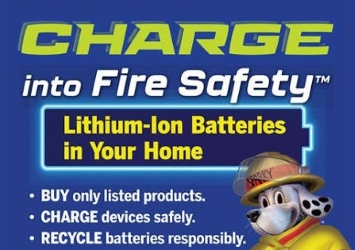
For example, the theme of this year’s fire safety week was “Charge Into Fire Safety: Safe Charging is a Superpower” focusing on lithium-ion battery safety, which has risen to the top of the list of emergency services concerns and challenges as the use of these batteries becomes an ever-increasing part of our everyday lives powering cell phones, laptops, tools, and other household devices, as well as, increasingly, electric cars, e-bikes, and other vehicles.
Toward that end, Steuben County Emergency Services recently posted the following safety tips:
- Purchase and use devices that are listed by a nationally recognized testing laboratory.
- Always follow the manufacturer’s instructions for charging.
- Only use the battery that is designed for the device.
- Only use the charging cord that comes with the device.
- Do not charge a device under your pillow, on your bed, or on a couch.
- Do not charge them near an exit or in a hallway.
- Do not keep charging the device or device battery after it is fully charged.
- Keep batteries at room temperature when possible. Do not charge them at temperatures below 32°F (0°C) or above105°F (40°C).
- Store batteries away from anything that can catch fire.
It becomes particularly urgent, however, as New York continues rapidly imposing all-electric mandates on all New Yorkers. It’s a serious concern for firefighters and first responders, one that we’re hearing more and more about across the 58th Senate District. In meetings around the region with local legislators, firefighters and EMTs, and other community leaders to discuss key challenges and issues, my state legislative colleagues and I have often heard a number of concerns centered on New York State’s all-electric mandates and the challenges, dangers, and uncertainty surrounding them – including the siting of battery storage facilities, the siting of solar farms on prime agricultural land, incentives for EMT training, the ability of the grid to handle what’s coming, and the overall uncertainty facing county governments, school districts, fire departments, and many others.

Battery fires have emerged as a particular concern and challenge requiring special response equipment and proper training in light of the reality that these battery fires burn more rapidly and far hotter than what most firefighters have experienced, and require many more resources, including massive amounts of water, to put out.
A national study in 2023 revealed that 40% of first responders and firefighters “had no training whatsoever in how to deal with electric vehicle fires and incidents.”
That’s not a comforting statistic, particularly here in New York State where Spectrum News reported late last year, “According to state records, there are more than 75,000 EVs registered in upstate New York. The state projects three million EVs on the road by 2030. By the end of this year, a state mandate (a mandate, I would note here, that was put in place by Albany Democrats under one-party control) requires all passenger cars, SUVs and pickup truck sales to be 35% electric. By 2030, that number climbs to 68%.”
In an article several years ago, the Firemen’s’ Association of the State New York (fasny.com) began highlighting the concern of what’s facing firefighters and first responders surrounding New York’s all-electric school bus mandate, “New York’s firefighters know how to respond to a fire or perform a rescue on the 47,000 diesel buses currently in service in New York. However, first responders’ training, procedures and equipment will need to evolve to reflect the transition from diesel to electric buses.”
It remains a relevant and critically important safety issue, one that the state has to continue prioritizing and that will demand a continually evolving response.
In addition to all the above, local volunteer fire departments across the region and statewide, as well as local leaders in every county I represent, have achieved an important victory following a longstanding effort to urge Governor Hochul to sign a critical new law.
FASNY President Donald J. Farrell has stated, “This is a transformational moment for volunteer emergency services in New York State. Quadrupling the volunteer firefighter and EMS tax credit from $200 to $800 sends a powerful message that New York recognizes the critical role volunteers play in protecting communities every day. Combined with allowing volunteers to receive both the state income tax credit and local property tax exemptions, this legislation delivers meaningful, long-overdue support for the tens of thousands of volunteers who sacrifice their time, leave their families, and answer emergency calls at all hours.”
During the 2026 legislative session, the Senate and Assembly, with unanimous bipartisan support, approved legislation I have long supported and proudly co-sponsored (S6233/A6790) to increase the state’s volunteer firefighter and ambulance worker income tax credit from $200 to $800 — the first increase since the program was established in 2006 — while also eliminating restrictions that currently prevent volunteers from receiving both the state tax credit and any locally authorized property tax exemptions.
We have been calling on the governor to finally take this step and sign the legislation into law, which she has now done.
FASNY President Farrell responded, “Volunteer firefighters across New York show up at 3 a.m. without asking why. They leave their families, their jobs and their beds to answer the call, and they do it for free. This is a real thank you to the men and women serving today, and it’s how we bring in the next generation.”