



“How does the enormous expansion of data centers fit in the advancement of Super and quantum computing”
A OPINION By Frederick Sinclair
The rapid growth in computer science and technology is shadowed by a fundamental question: Are we building the computer infrastructure that science and progress genuinely needs, or are we also participating in an economic and geopolitical race that has taken on a life of its own? As we consider this we should not assume the answer is entirely one or the other, as scientific necessity, commercial incentives, national security, and competitive pressures can actually be operating simultaneously.
Let’s start by distinguishing supercomputers from quantum. Supercomputers provide conventional computing power, utilizing large numbers of CPUs and GPUs, to perform calculations in parallel. It is particularly valuable in climate modeling, nuclear physics research, astrophysics, fluid dynamics and advanced materials design. Its strength is the ability to perform enormous numbers of conventional calculations and analysis quickly and reliably. High bandwidth memory, fast interconnection and packaging enables many processors to work together.
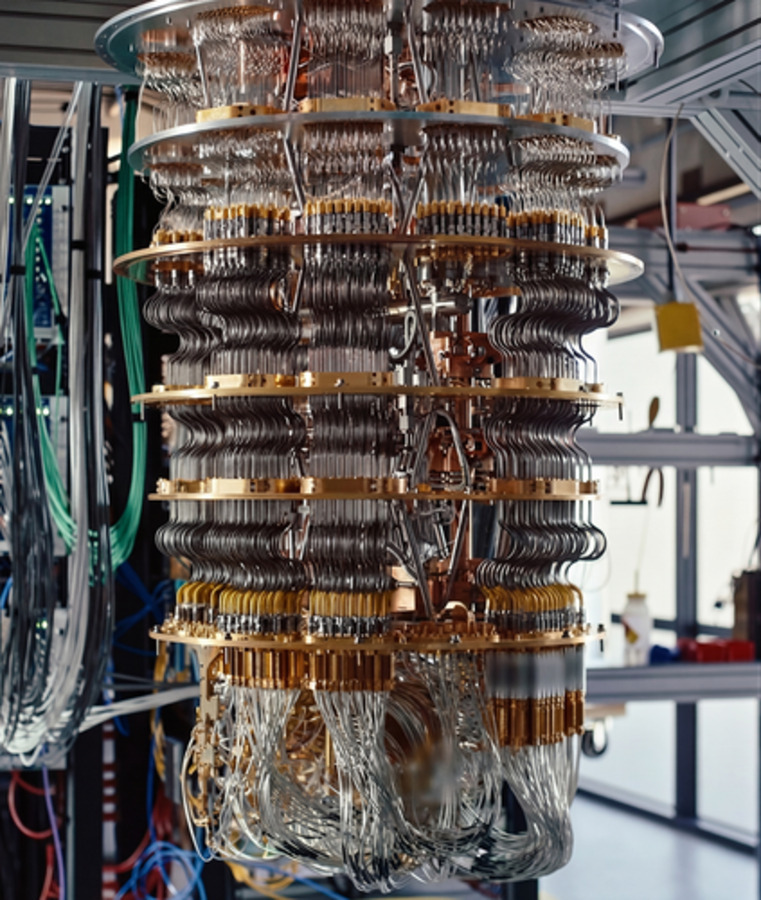
Quantum computers use quantum-mechanical properties to process information encoded in qubits. Depending on the hardware, these may use superconducting circuits, trapped ions, photonics or other advanced physical platforms. Their promise lies in solving certain problems, including aspects of quantum chemistry, materials science and special mathematical calculations. They are not universally faster than conventional supercomputers and are not expected to replace them for general scientific computing. Some quantum systems also require specialized control electronics and extremely low operating temperatures or other carefully controlled physical conditions.
Conventional supercomputer processors depend heavily on semiconductor fabrication, including sophisticated lithography ( microscopic printed circuits) and complex chip packaging. Quantum hardware may also use semiconductor technology , but some approaches rely on superconducting circuits, photonics or trapped ions. There is no single or universal “quantum chip”.
The ‘race’ in AI or computer supremacy is fueled when one country may have excellent research but still depends on foreign suppliers for advanced chips, manufacturing of specialized materials or essential components. The finish line for leaders in the industry involves winning the contest to build the fastest machine; and controlling the supply chain that makes the machines possible.

So, how does the enormous expansion of data centers fit in the advancement of Super and quantum computing? There are, legitimate reasons to build powerful computing facilities, and that has been achieved at many of the research centers, universities and manufacturing locations. These scientific high performance computing facilities solve research and engineering problems. And then, there are the commercial cloud and AI (supercomputing) infrastructure facilities serving business models, profit motives, data storage and associated workloads. The wider ‘data economy’: online services, advertising,streaming,financial transactions, social media, and other activities demand enormous computation and storage. New large scale data centers, in most cases, are not being built for quantum or scientific research. Conversely, science oriented smaller scale computing facilities can produce genuine public benefits that offset substantial cost or negative impact. Energy consumption is one of the obvious issues that needs weighing in, along with the field of myriad other pluses and minuses. The US Department of Energy published a report in 2026, estimating that data centers could consume 11.8 % of US electricity by 2030. There are other impacts on water resources, land use, noise, infrasound, property values etc. which need to be fairly weighed against positive contributions to the function of the community and public at large. Among the positives might be job creation, tax revenue or payment to local communities (in lieu of taxes) and grants to local groups (fire companies, first responders and community projects) etc.
Questions that need answering are: How much of the expansion (data center) is supported by documented or scientific need and how much serves commercial, AI demand and other profitable activities? Who pays for the power infrastructure, transmission upgrades, water source and other local costs? What are the environmental impacts, positive and negative as well as alternative mitigation measures? Are the computational and/or financial benefits shared broadly or concentrated among a relatively small number of companies and investors? It is important that each proposed facility be evaluated according to it’s purpose, local costs, impacts and public benefit, as opposed to generic impact assessment for entire states or regions. Could improved algorithms, more efficient chips and better use of existing facilities, or improvement in high-speed fiber optic connections, accomplish some of the data processing needs without disruptive expansion?
It is important to consider that current scientific or economic need or purpose does not automatically justify every future level of energy consumption, or need for computing capacity. More computing power is not the same as more scientific progress and progress should be measured by useful outcome not merely by the number of calculations performed per second. We should be mindful of the problem we are trying to solve and what level of computing power is actually necessary to solve it. The question is not whether humanity should advance its computing capacity, but, whether we can distinguish the computing power that advances human knowledge ,from the expansion that primarily advances commercial or national competition.
The need of a process for analysis and weighing of impact, in review of data center proposals and expansion, is already in place within federal, state and local statutes. The National Environmental Policy Act (NEPA) requires environmental impact review of federal policy and associated projects. States have initiated similar frameworks for development of Environmental Impact Statements (SEQR in NY), and localities have the authority to perform impact review, implement Zoning regulations and establish in code, procedures for review of construction permit applications; approval or denial. All of these laws provide for public review, comment and public hearings. Elected officials cannot, however, be expert in all fields. Costs of appropriate environmental review, for large project permit applications, can be high and require special independent consulting; fortunately, these expenses can be legally charged to the applicant. The harsh reality is that powerful entities apply enormous pressures, to all levels of government, in order to prevent in depth scrutiny and weighing of their project impacts. Elected officials need to reinforce existing policy and strengthen procedures for meeting their primary responsibility to represent and protect. The public should insist on it!
Note: This article benefited from discussions with ChatGPT, an AI assistant developed by OpenAI. Those discussions helped in exploring the relationships between scientific advancement, commercial interests, national security and the growing demands of commercial infrastructure. This author has utilized these exchanges as a starting point for initial analysis and takes responsibility for the final content, conclusions and recommendations.
Fred Sinclair is an Alfred writer, philosopher, and curious mind. He writes a weekly column for multiple local media outlets on topics you won’t find in the mainstream. Contact him anytime, fpsinclair@yahoo.com