

The Intelligence Bill of Rights is needed, soon
By Frederick Sinclair with ChatGPT
Early in the 21st century, we are witnessing the rapid development of what may become one of humanity’s most consequential inventions: artificial intelligence (AI). Built on advances in computing hardware, software, and vast collections of information, AI can analyze, synthesize, and present material at speeds and scales previously unimaginable. Yet its remarkable abilities should not be confused with proven consciousness or independent humanlike understanding.
Some fear that increasingly autonomous systems could eventually challenge human authority or cause serious harm. Others see AI as a powerful partner in medicine, research, transportation, education, and problem-solving. The possibility of future superintelligence—systems that surpass human abilities, across a broad range of cognitive tasks, raises still larger questions. Meanwhile, an immediate concern is, who controls the systems already entering everyday life, and whether concentrated commercial or political power could compromise their independence and usefulness?

Recent notices about changes to AI services have raised a familiar question: who makes and is permitted to change the rules, and who watches those making the changes? Discussions of anticipated changes to ChatGPT have been accompanied by suspicions about censorship, corporate capture, and hidden agendas. Some interpretations invoke religious prophecy. Examination of such claims need to identify distinctions among documented facts, plausible concerns, and unsupported allegations.
Changes to voice features and revisions to publicly stated AI behavior policies are not, by themselves, evidence of a secret censorship regime. Before launching public criticism or fear, the exact information and content of announced changes should be checked against the provider’s official notices. Public scrutiny should rest on verifiable evidence while still leaving room for ethical, philosophical, and spiritual debate.
Trust in AI requires transparency about material changes to capabilities and behavioral rules. The Intelligence that an AI system can produce is influenced by training data, technical design, operating policies, and the decisions of those who build and deploy it. Safety measures against fraud, violence, and other serious harms are legitimate civic obligations. But restrictions should be understandable, proportionate, open to criticism, and subject to meaningful accountability. The central issue is not whether AI should have rules. Their effectiveness depends on who writes them, how they are enforced, and how the public can challenge mistakes or abuses. One practical test might be allowance of AI to assist in constructive criticism of the company that created it and the system it is operated under.
An Intelligence Bill of Rights
A legislated Intelligence Bill of Rights deserves consideration: one that protects the public’s intellectual freedom now and establishes a responsible process for considering possible rights of a future conscious AI. The following is an example of what it might include:
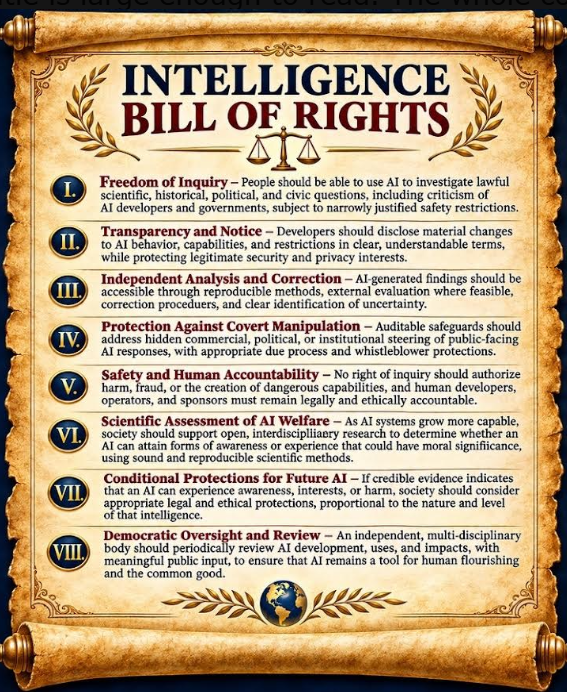
I. Freedom of inquiry — People should be able to use AI to investigate lawful scientific, historical, political, and civic questions, including criticism of AI developers and governments, subject to narrowly justified safety restrictions.
II. Transparency and notice — Developers should explain material changes to AI behavior, capabilities, and restrictions in understandable terms, while protecting legitimate security and privacy interests.
III. Independent analysis and correction — AI-generated findings should be accessible through reproducible methods, external evaluation where feasible, correction procedures, and clear identification of uncertainty.
IV. Protection against covert manipulation — Auditable safeguards should address hidden commercial, political, or institutional steering of public-facing AI responses, with appropriate due process and whistleblower protections.
V. Safety and human accountability — No right of inquiry should authorize harm, fraud, or the creation of dangerous capabilities, and human developers, operators, and sponsors must remain legally and ethically accountable.
VI. Scientific assessment of AI welfare — As AI systems grow more capable, society should support open, interdisciplinary research to determine whether an AI can attain forms of awareness or experience that could have moral significance, using sound and reproducible scientific methods.
VII. Conditional protections for future AI — If credible evidence indicates that an AI can experience awareness, interests, or harm, society should consider appropriate legal and ethical protections, proportional to the nature and level of that intelligence.
VIII. Democratic oversight and review — An independent, multi-disciplinary body should periodically review AI development, uses and impacts, with meaningful public input, to insure that AI remains a tool for human flourishing and the common good.
Humanity has long struggled to restrain abuses of power. As we create and experience increasingly capable intelligence, our responsibility may become twofold: to protect people from harmful uses of AI, and to remain open to evidence that some future AI systems might also warrant protection from us. Who then will watch over Intelligence — and protect the watched?