


Jim Moore / February 15, 2026
A recent feature from the Finger Lakes Land Trust takes readers deep into the geological story behind the region’s iconic waterfalls, explaining how an ancient layer of rock known as Tully Limestone helps shape some of the most dramatic scenery in central New York.
In the article, titled “Anatomy of a Waterfall: Tully Limestone,” the organization outlines how the Finger Lakes landscape was forged over hundreds of millions of years. The piece traces the story back to the Devonian Period, when a shallow inland sea covered what is now New York State. Sediments deposited on the sea floor eventually hardened into layers of limestone, shale, and sandstone through a process known as lithification.
The Land Trust explains that the real transformation of the landscape came much later. Over the past 2.5 million years, repeated glaciations carved deep north–south valleys that would eventually hold the Finger Lakes. When the glaciers retreated, tributary streams were left suspended above the newly deepened valleys, creating the conditions for waterfalls to form.
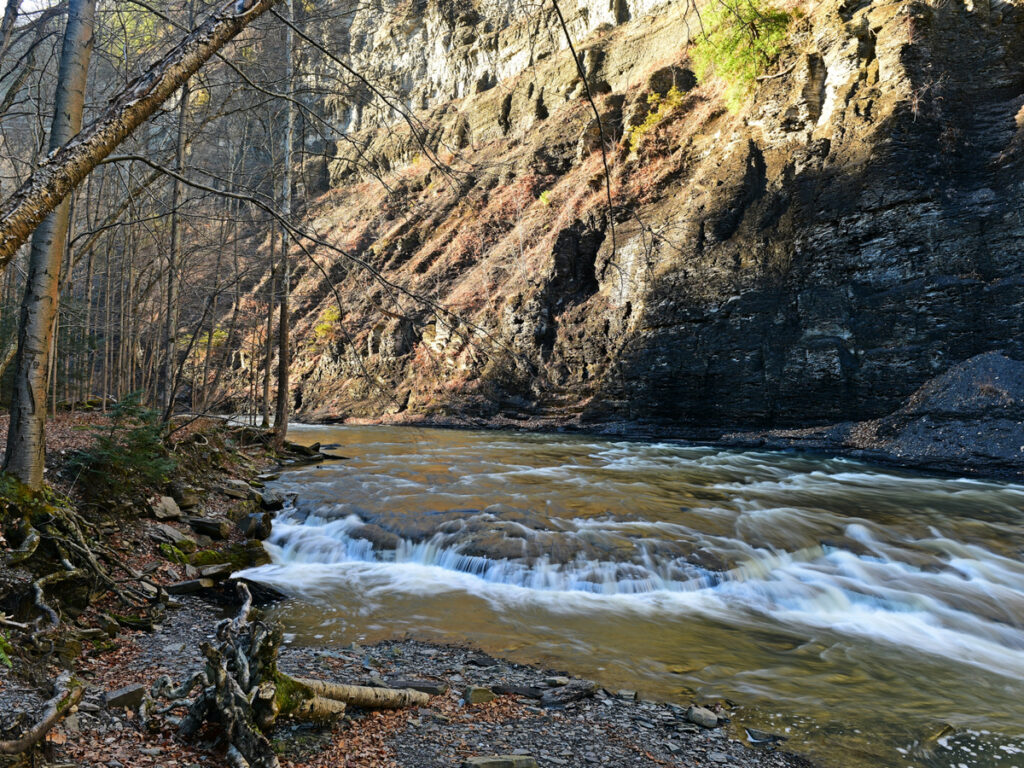
Central to the article’s explanation is the concept of differential erosion. The Land Trust describes how softer rocks, such as shale, erode more quickly than harder rock layers like limestone. When a stream encounters a resistant cap of limestone sitting atop weaker shale, the shale wears away faster, undercutting the stronger rock. As the softer layer recedes, a vertical drop develops — forming a waterfall. Over time, chunks of the harder limestone break away, causing the waterfall to gradually migrate upstream.
The article highlights Tully Limestone as a particularly important rock layer in this process. First identified near the village of Tully in the 19th century, the limestone band stretches across much of central New York. Its strength and thickness make it especially resistant to erosion, which is why it frequently serves as the “cap rock” over waterfalls throughout the region.
To illustrate the concept, the Land Trust points to several well-known examples where Tully Limestone plays a visible role. These include Tinker Falls, Carpenter Falls, Ludlowville Falls, and the lower falls at Taughannock Falls State Park. In each case, the waterfall forms where durable limestone overlies more easily eroded shale.
Beyond spotlighting specific locations, the article emphasizes that the same geological pattern is repeated across the region. Even small tributaries crossing the Tully Limestone outcrop create unnamed cascades, each one a product of the same ancient rock sequence and ongoing erosion.
By breaking down the science behind these scenic landmarks, the Finger Lakes Land Trust’s article offers readers a deeper appreciation for the forces that continue to shape the landscape. What may appear to be timeless natural features, the organization notes, are in fact dynamic formations — slowly evolving as water and rock interact over vast stretches of time.
The feature serves as both a geology lesson and a reminder that the Finger Lakes’ beauty is rooted in processes that began hundreds of millions of years ago and continue today.
See the very interesting article here: https://www.fllt.org/anatomy-of-a-waterfall-tully-limestone/