


Staff Report / August 1, 2026
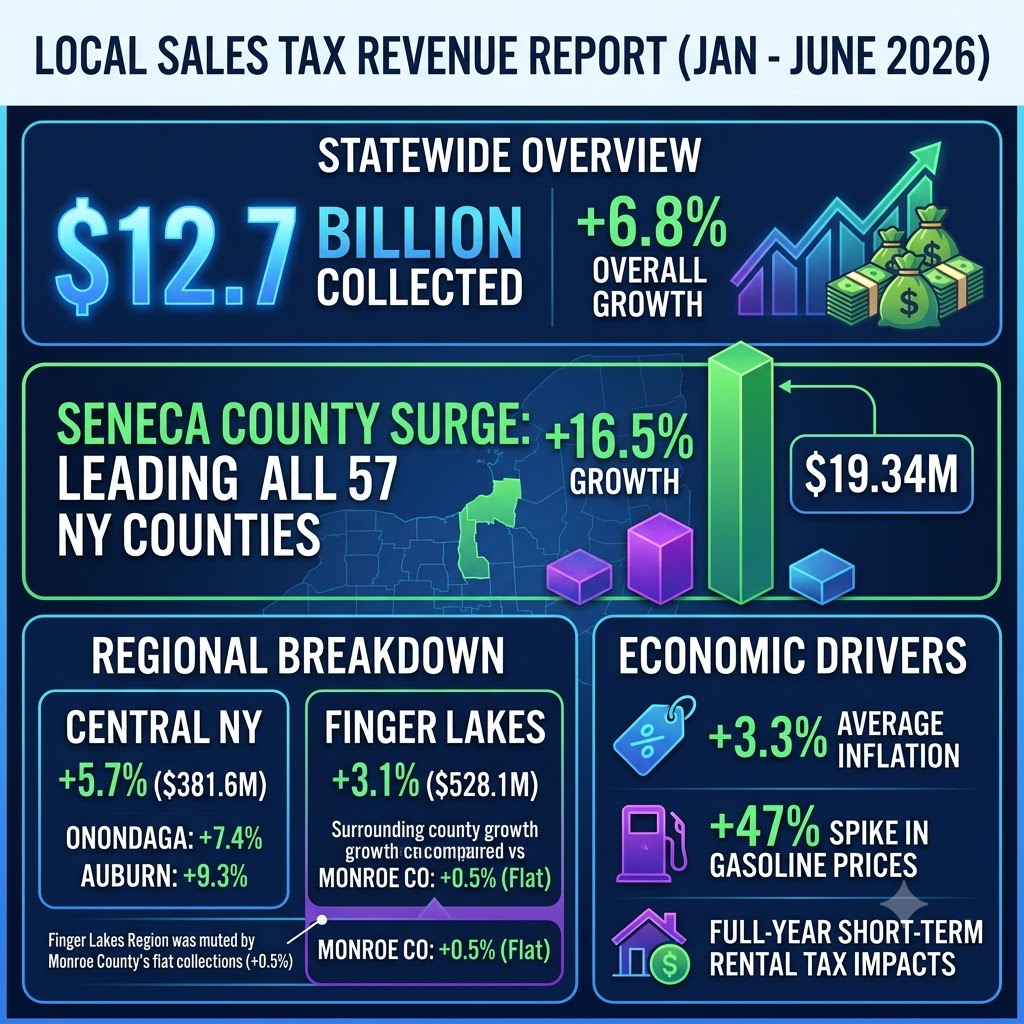
ALBANY – Local sales tax collections rose across the Finger Lakes and Central New York during the first half of 2026, offering local governments a boost in revenue, though performance varied sharply across individual counties. Statewide, local sales tax collections reached $12.7 billion, a 6.8% increase compared to the same period in 2025, driven by stronger second-quarter spending and rising consumer costs. Outside of New York City, total collections jumped 5.6% to $6.1 billion, doubling the rate of growth recorded during the first half of the previous year.
Central New York outperformed the state-defined Finger Lakes region, posting a 5.7% increase to $381.6 million. Onondaga County drove much of that growth with a 7.4% rise to $259.4 million, while the City of Auburn posted a strong 9.3% gain. Conversely, Cortland County was one of only five counties statewide to report a decline, dropping 2.8%. The Finger Lakes region saw a more modest 3.1% overall growth, held back by a nearly flat 0.5% gain in Monroe County due to a $14.1 million technical adjustment. However, Seneca County led all 57 New York counties outside New York City with a massive 16.5% surge in collections.
Key highlights and economic takeaways from the Comptroller’s report include:
- Seneca County Leads Statewide Growth: Seneca County’s revenue surged 16.5% to $19.34 million, bolstered by an impressive 22.3% spike in the second quarter alone.
- Southern Tier & Finger Lakes Outliers: Genesee County ranked second statewide with a 12.5% increase, while neighboring Steuben and Schuyler counties in the Southern Tier saw solid gains of 8.5% and 7.4%, respectively.
- Inflation Driving Revenue: Officials cautioned that higher collections do not necessarily reflect greater consumer purchasing power, as an average 3.3% inflation rate and a 47% spike in May gasoline prices forced shoppers to pay more for the same goods and services.
- Short-Term Rental Tax Impact: Year-over-year comparisons were also lifted by a state law taxing short-term rentals that went into effect in March 2025, capturing a full six months of revenue in tourism-heavy Finger Lakes communities.