


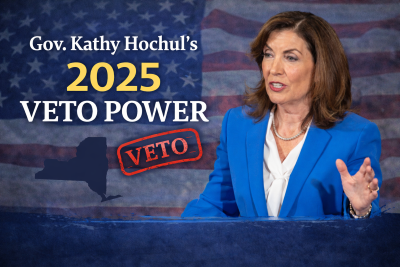
What Kathy Hochul’s 2025 Veto Strategy Reveals About Power, Polarization, and the Disappearing Middle
A COLUMN By Clay “Tiger” Hulin,
For decades, New York governors have followed a familiar end-of-year ritual: carrying a thick stack of unsigned bills into the Christmas holiday. In Albany, this practice is so common it even has a nickname, the “Christmas Stack.” Controversial legislation is often left unsigned until deadlines force a quiet resolution, allowing governors to avoid public confrontation while maintaining leverage over lawmakers.
In 2025, that did not happen.
For the first time since taking office, Governor Kathy Hochul entered the holiday season having acted on nearly every bill sent to her desk. Of the 856 bills passed by the Legislature, Hochul either signed or vetoed all but two. She vetoed 140 bills, roughly sixteen percent, marking one of the most assertive veto years of her tenure.
At a minimum, this represents action at the state level. Whether one agrees with her decisions or not, choosing finality over delay is a departure from Albany’s long-standing habit of kicking difficult questions into the new year.
Action Versus Negotiation
Procedurally, Hochul’s approach broke from precedent. Governors often use inaction as a negotiating tool, allowing bills to linger unsigned while extracting concessions or avoiding political fallout. By contrast, Hochul closed the loop early and publicly.
That decisiveness came with tradeoffs.
Vetoes replaced negotiation more often than compromise. Some measures were rejected without a clearly articulated alternative path forward. Finality reduced legislative leverage, cutting short the informal bargaining that typically stretches into late December.
This does not automatically make the strategy wrong. It does, however, shift power decisively toward the executive branch.

Reaction From the Left
Criticism from the political left has been sharp, though not uniform.
Progressive lawmakers and advocacy groups expressed frustration over repeated vetoes of the Grieving Families Act, which Hochul rejected for the fourth consecutive time. Supporters argue the bill would modernize wrongful-death law and expand access to justice. Hochul has countered that it would increase insurance costs and destabilize liability markets.
Beyond that single bill, left-leaning critics have raised broader concerns about executive centralization, arguing that frequent vetoes narrow the Legislature’s role and reduce collaborative policymaking.
Notably, even many critics acknowledge that Hochul did not hide behind delay. The objection is less that she failed to act and more that she exercised power in ways they oppose.
Reaction From the Right
Reaction from the right has been more surprising, and more selective.
Conservative commentators and business-oriented groups have welcomed vetoes that blocked liability expansion and regulatory growth. From this perspective, Hochul’s actions are viewed not as ideological alignment but as outcome-driven restraint. Blocking measures seen as increasing costs for insurers, municipalities, hospitals, and small businesses earned cautious approval.
This support is transactional, not philosophical. The right is not endorsing Hochul’s broader agenda on housing, public health, education, or spending. It is responding favorably to specific decisions that align with economic priorities.
Ironically, some conservatives support this approach precisely because they distrust future governors. Limiting statutory lock-ins and preserving executive flexibility is seen as a hedge against administrations yet to come.
Polarization and the Vanishing Center
What makes 2025 notable is not consensus, but fragmentation.
In an increasingly polarized political environment, agreement across ideological lines is rare. Support or criticism is expected to be total rather than selective. As a result, moments of cross-pressure, criticism from the left combined with limited approval from the right, feel almost anomalous.
Moderation, pragmatism, and realism have largely lost their standing as political identities. Walking the middle of a policy debate no longer reads as neutral; it is often interpreted as covert opposition by both sides. If a position does not align fully with one camp, it is assumed to belong to the other.
Hochul’s 2025 veto record disrupted familiar narratives. The left cannot credibly argue that she avoided decision-making. The right cannot claim she rubber-stamped progressive legislation. Instead, both sides are forced to contend with a more complicated reality.

Quiet Governance Beyond New York
Several Democratic governors across the country appear to be doing something similar, quietly closing loops, reducing ambiguity, and rebuilding state capacity from the inside out rather than lingering in negotiation theater.
Governors such as Tony Evers in Wisconsin, Andy Beshear in Kentucky, and Michelle Lujan Grisham in New Mexico have pursued different paths shaped by different political realities, yet share a common governing instinct. None governs as if politics is performance. Each has focused on stabilizing systems, restoring administrative coherence, and keeping institutions functioning after the cameras move on.
Their leadership styles differ, but the throughline is temperament rather than ideology. Governing is treated less as spectacle and more as stewardship.
What 2025 Ultimately Shows
New York did not experience legislative paralysis in 2025. The Legislature passed broadly, and the governor responded decisively. What changed was not the volume of lawmaking, but the method of resolution.
The central question is no longer whether delay is preferable to decision, but whether clarity is worth the loss of negotiation.
In an age addicted to utopian fantasies and dystopian fears, governing remains stubbornly ordinary. Good governance is quiet, procedural, and deeply boring. At its best, it looks like Sunday morning church amplified, not for show, but for stability: the same rituals, the same rules, carried out because continuity itself is the point.
Whether this model strengthens governance or undermines collaboration remains an open question, one likely to shape Albany’s politics well beyond this legislative session.
New York Focus. (2025). Here’s every bill that Kathy Hochul vetoed in 2025. Here’s Every Bill That Kathy Hochul Vetoed in 2025 | New York Focushttps://nyfocus.com
New York State Legislature. (2025). Bill status and legislative records for the 2025 session https://nyassembly.gov/
Office of the Governor of New York. (2025). Governor Hochul’s bill approvals and veto messages. https://www.governor.ny.gov
Clay Hulin is a Cattaraugus county writer, Registered Nurse, and family guy. You can reach him anytime, claymation_88@yahoo.com